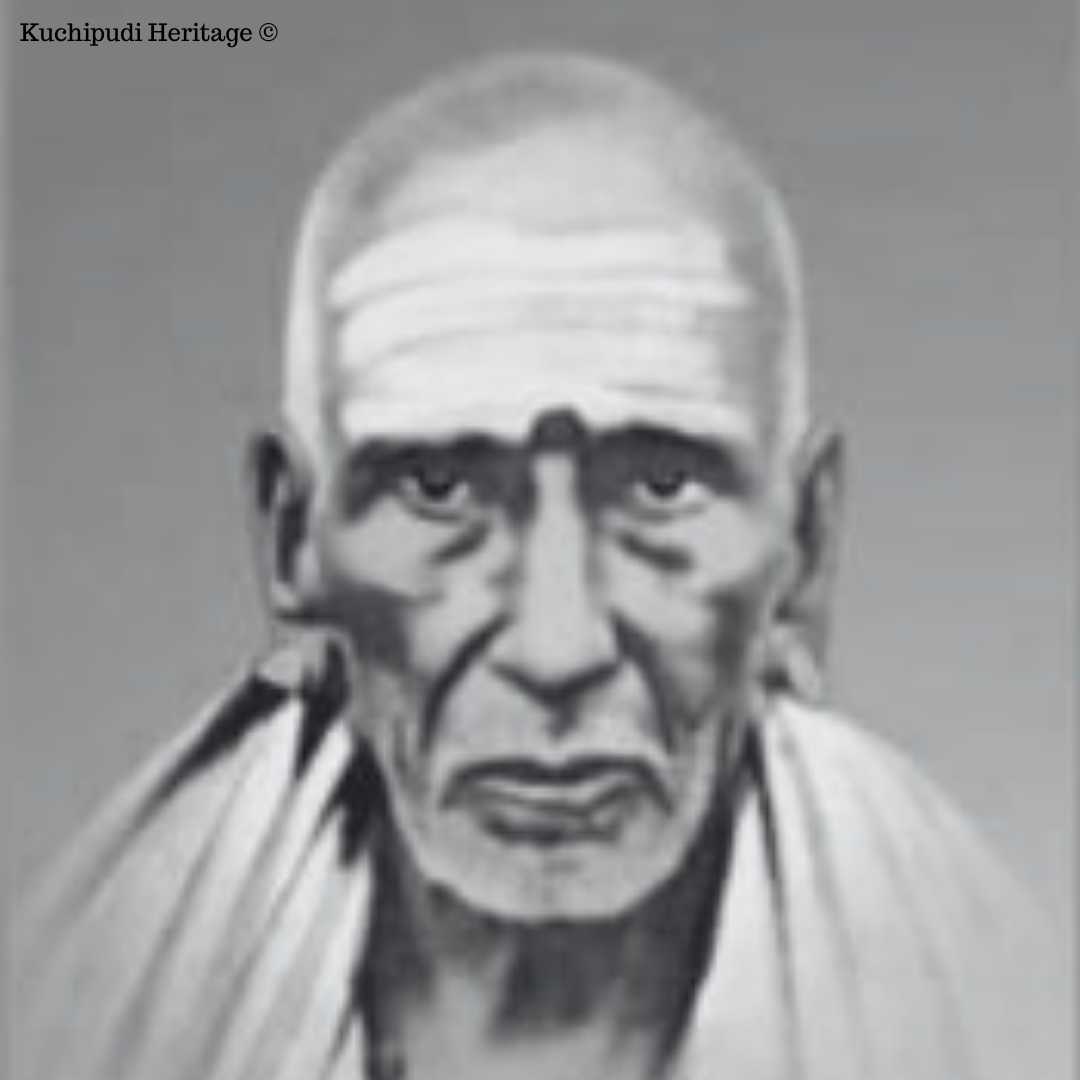
late. Chinta Venkataramayya
(1860-1949)
born to Arundhatamma and Sivaramayya, emerged as a distinguished figure in the realm of Kuchipudi dance. Trained under the guidance of Venkataratnam, his elder brother, and Yeleswarapu Narayanappa, Venkataramayya showcased exceptional talent from a young age. Renowned as a performer, instructor, and principal narrator, Venkataramayya’s journey on stage began at the tender age of eight, portraying various characters including both male and female roles. Later, he transitioned into the role of Sutradhara, the principal narrator, for Kuchipudi dance dramas. He founded the Venkatarama Natya Mandali, a pioneering organization dedicated to the training and dissemination of Kuchipudi dance. Under his leadership, this group played a crucial role in popularizing Kuchipudi, presenting numerous dance dramas across various regions until 1936. Notable productions included Prahlada Charitra, Usha Parinaya, Sasirekha Parinayam, Gayopakhyanam, Ramanataka, and Mohini Rukmangada. Readmore..

late. Vempati Venkatanarayana
(1871-1935)
son of Punnamma and Kodandaramayya, received his training in the Kuchipudi art form from his father. Renowned for his portrayal of female roles such as Satyabhama, Dadinamma, and Balintaveshas, Venkatanarayana continued his performances until the age of sixty, an exceptional feat in the realm of performing arts. Notably, his portrayal of Dadinamma, performed for three hours while tied to a cot, showcased his exceptional talent and dedication. Venkatanarayana’s mastery of talaprastara (rhythmic footwork) and facial expressions earned him the title of Abhinava Satyabhama. He also achieved remarkable success by performing Bhamakalapam over a thousand times across the Andhra region. During a period when drama companies from Dharwad dominated the Andhra region (1880-1930), Venkatanarayana absorbed stage decor and presentation techniques, integrating them into Kuchipudi dance dramas to elevate the performance standards. Readmore..
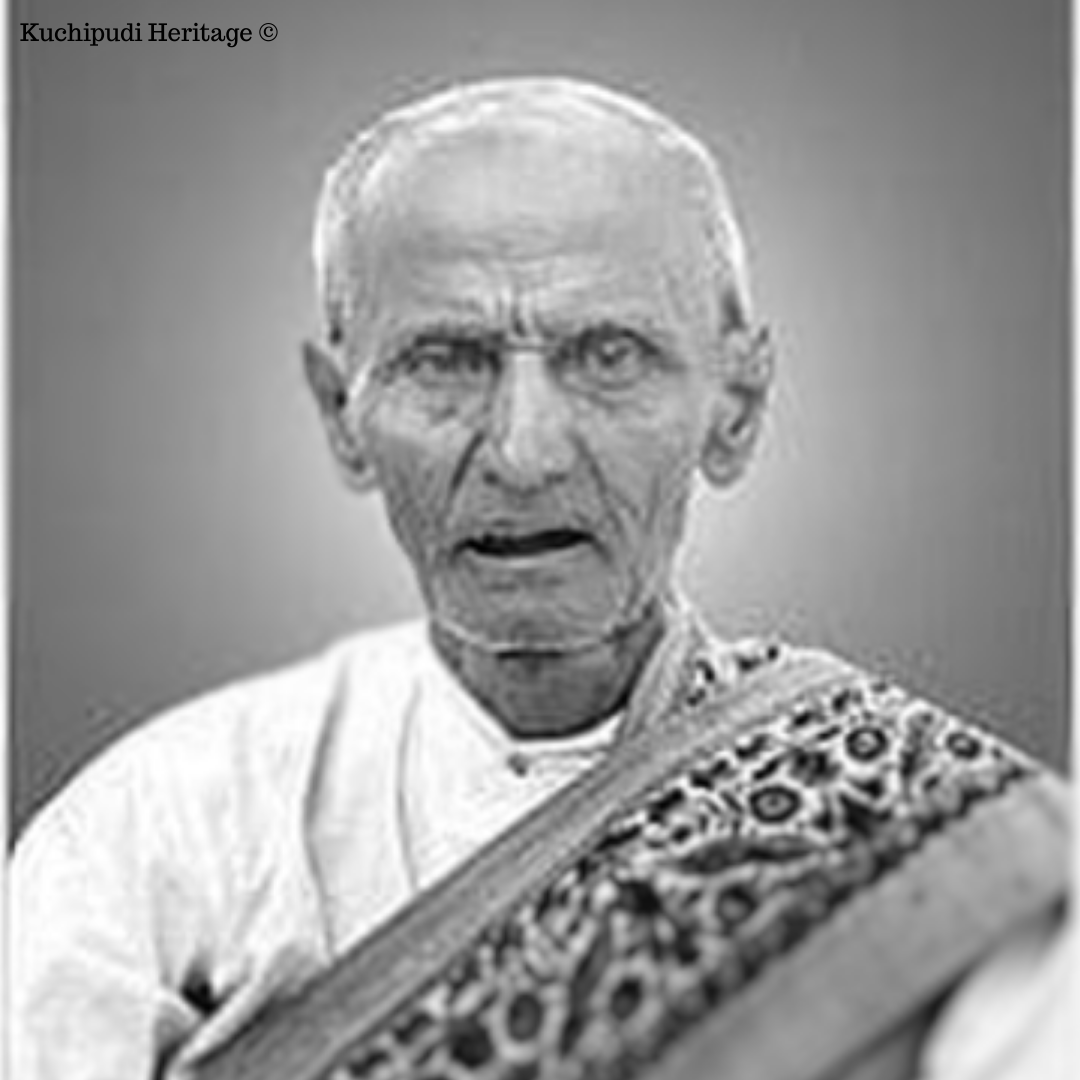
late. Vedantam Lakshminarayana Sastry
(1886-1956)
son of Savitramma and Venkatesam, honed his dance skills under the guidance of Vempati Venkatanarayana, mastering performances of Bhamakalapam and Gollakalapam with remarkable elegance and sophistication. A luminary in both the theoretical and practical realms of dance, music, and rhythm, Lakshminarayana Sastry is credited with revolutionizing the traditional dance drama form of Kuchipudi by introducing solo performances. A visionary from a young age, he choreographed numerous solo pieces such as Astapadis, Padams, Javalis, and songs from Krishna Karnamritam and Pushpabana Vilasam, enriching them with profound Sattvikabhinaya expressions. Lakshminarayana Sastry’s teaching methodology was distinctive, characterized by individualized attention to his disciples, fostering their unique talents. Among his notable students were Vedantam Jagannadha Sarma, Vempati Peda Satyam, Vempati Chinna Satyam, and Ayyanki Tandava Krishna. Read more..

late. Tadepalli Perayya
(1886-1942)
born to Gauramma and Subbarayudu, distinguished himself not only as a performer but predominantly as a revered guru in the realm of Kuchipudi. Heralding from the era of pre-independent India, Perayya stands as one of the pioneering figures who endeavored to transcend the traditional boundaries of Kuchipudi and introduce it to a broader audience. His expertise in portraying Bhama and Gollakalapas on stage garnered admiration, yet Perayya’s legacy is primarily rooted in his role as a mentor. Venturing beyond conventional norms, he embarked on a mission to impart Kuchipudi training to devadasis from Meduru and Nangigadda, orchestrating their performances and assuming the role of Sutradhara (principal narrator) himself. Notable among his proteges were Krishnaveni from Nangigadda and Balatripura Sundari from Repalle. Perayya’s distinctive style as a Sutradhara, characterized by his astute presence of mind and ability to establish a profound connection with the audience, earned him widespread acclaim. Readmore..
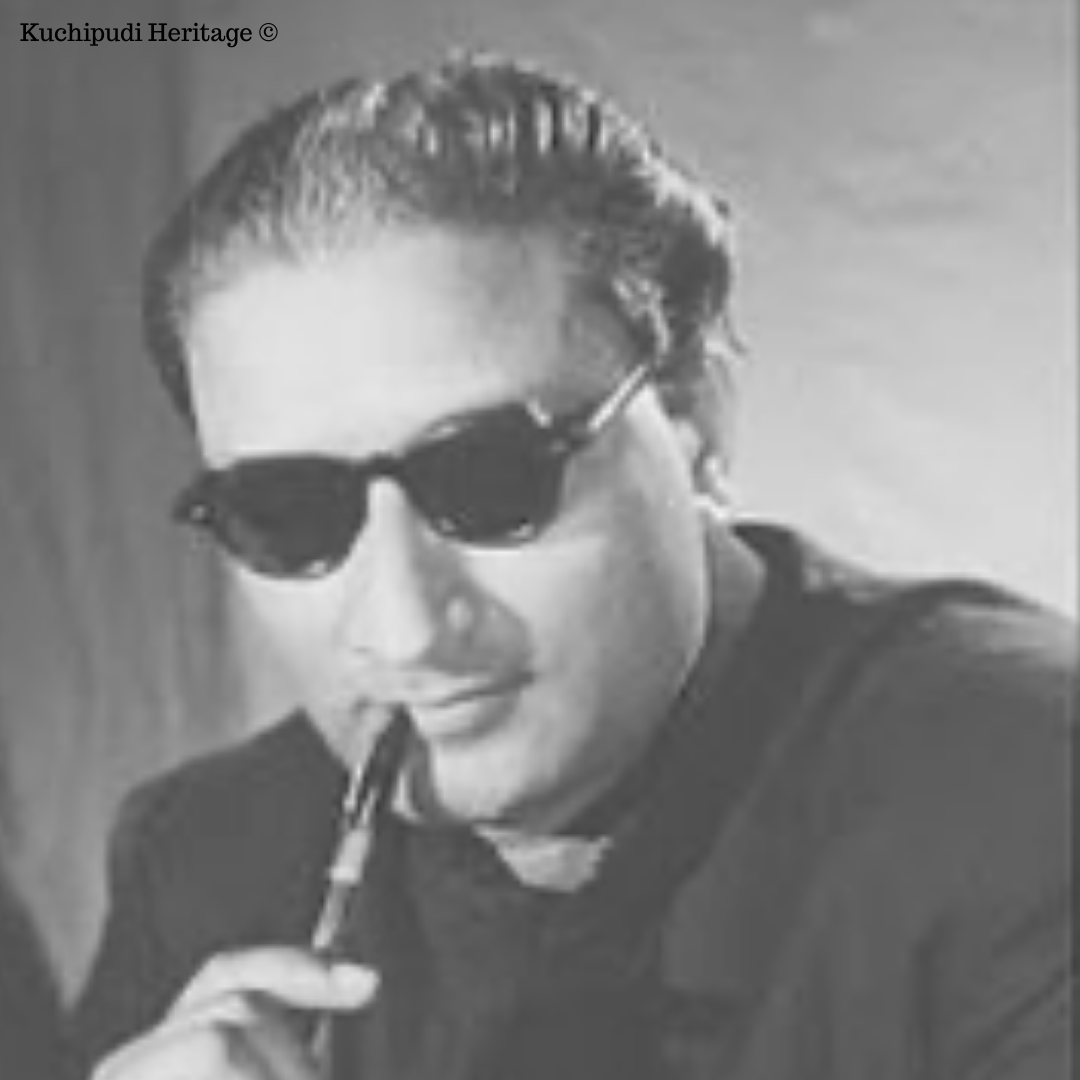
late. Vedantam Raghavaiah
(1919-1971)
born to Sitamma and Ramayya, received his early training under the guidance of Chinta Venkataramayya, alongside excelling in music. As a prodigious child artist, Raghavayya showcased his artistic brilliance through roles like Prahlada, Lava, Kusa, and Lohitasya. Notably, his portrayal of female characters such as Usha, Mohini, Sita, Chandramati, Lilavati, and Satyabhama earned him widespread acclaim. His depiction of Usha was particularly revered, considered unsurpassed even today. Later in his career, he transitioned to portraying male roles like Krishna, Harischandra, and Hiranyakasipa. In 1941, Raghavayya embarked on nationwide tours alongside Vempati Peda Satyam and Tandava Krishna, captivating audiences with their performances. He ventured into the realm of cinema at the behest of Gudavalli Ramabrahmam, featuring in films like “Rytubidda,” “Rukmangada,” “Mayalokam,” and “Garuda Garvabhangam.” Additionally, he provided dance direction for films such as “Tyag ryya” and “Balaraju,” becoming the first Kuchipudi artist to venture into professional filmmaking. Readmore..

late. Vedantam Parvateesam
(1920)
emerged as a prominent figure in the realm of Kuchipudi, following in the footsteps of his mentors, including Chinta Venkataramayya, Vedantam Ramakrishnayya, and Vedantam Raghavayya. His musical acumen was honed under the guidance of Yeleswarapu Sitaramanjaneyulu. Founding member of the Siddhendra Kalakshetram in 1957, alongside Banda Kanakalingeswara Rao, Parvatisam dedicated himself to this institution until his retirement as its Principal. Over fifty years, he imparted his knowledge of Kuchipudi to numerous students, including notable disciples like Vedantam Rattayya Sarma, Yeleswarapu Nageswara Sarma, Chinta Ramamurthy, and Pasumarthy Kesava Prasad. His performances, portraying iconic roles like Krishna, Abhimanyu, and Chandramati, left an indelible mark on the Kuchipudi landscape. Beyond his roles as a performer and teacher, Parvatisam showcased his literary prowess through his writings. His compositions and dance dramas, featured regularly in Natyakala, a monthly journal by the Andhra Pradesh Sangeet Natak Akademi, Hyderabad. Readmore..

late. Vempati Peda Satyam
(1922-1982)
known as Peda Satyam, was born to Sitamma and Subba Rao. He commenced his dance training at the age of thirteen under Chinta Venkataramayya and received advanced instruction from Vedantam Lakshminarayana Sastry. Additionally, he studied Bharatanatyam and Kathakali under Ramgopal of Bangalore and pursued painting under Adivi Bapiraju’s guidance. Initially associated with Venkataramana Natyamandali and later with Vedantam Lakshminarayana Sastry’s troupe, Peda Satyam briefly explored painting due to a lack of encouragement from his mentors. However, he returned to dance in 1940, featuring in the film “Meerabai” performing the Kapali dance. Subsequently, he co-founded Natyasangha with Vedantam Raghavayya and Ayyanki Tandava Krishna, embarking on nationwide tours and establishing the Kuchipudi Kala Vignana Kendram in Madras in 1943. In collaboration with Raghavayya, Peda Satyam introduced new repertoire such as Radha Krishna and Siva Parvati into Kuchipudi dance. Readmore..
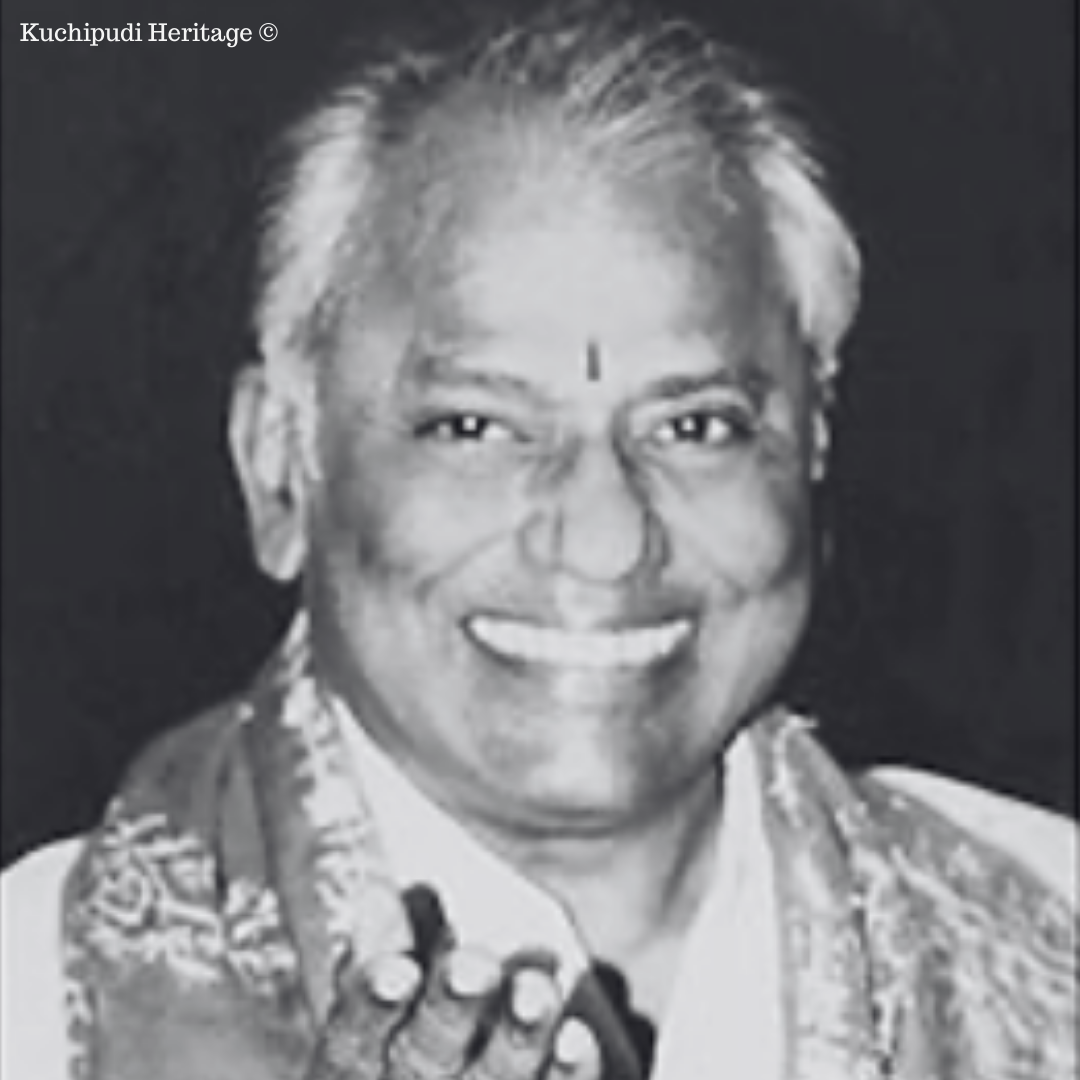
late. Pasumarthi Krishna Murthy
(1927)
born to Adilakshmi and Ramayya, received his training under the tutelage of Chinta Venkataramayya and Chinta Ramamurthy. Renowned for his exceptional abhinaya skills, Krishna Murthy gained popularity for his portrayal of female roles such as Satyabhama, Gollabhama, Usha, and Sasirekha. His association with Chinta Vari Melam during his youth honed his ability to portray female characters with exquisite finesse.In the early stages of his career, Krishna Murthy performed solo pieces during intervals of dance dramas, showcasing his talent in Kuchipudi’s special solo numbers like Tarangas and Sabdas. Following in the footsteps of Vempati Peda Satyam and Vedantam Raghavayya, Krishna Murthy moved to Madras in pursuit of better opportunities. He ventured into cinema, directing dance sequences for nearly two hundred films across various languages, including Telugu, Tamil, Kannada, Malayalam, and Hindi. Known for his imaginative choreography, Krishna Murthy’s dance compositions for comedy song sequences were highly entertaining. He was acclaimed for his seamless blending of classical and folk elements. Readmore..

late. Mahankali Satyanarayana
(1940-1977)
the second son of Sriramulu, embarked on his artistic journey with early training in dance under his father’s guidance. Later, he refined his skills under the tutelage of Chinta Venkataramayya and explored the realm of music under Challapilla Sitaramayya’s mentorship. Renowned for his exceptional talent, Satyanarayana carved a niche for himself in the portrayal of Tamasik characters, rivaling only Hari Venkatachalapati in his mastery. His performances exuded natural ease and spontaneity, with portrayals of characters like Virabahu and Viswamitra earning him unparalleled acclaim.Particularly noteworthy were his depictions of Banasura and Hiranyakasipa, characters torn between conflicting emotions, portrayed with remarkable depth and conviction. Additionally, his portrayal of Yamadharmaraja showcased his histrionic talents and commanding presence on stage. Satyanarayana’s artistic journey saw him collaborate with esteemed colleagues under the banner of Mahankali melamu, including Vedantam Raghavayya, Bhagavatula Suryanarayana, Darbha Venkateswarulu, and Vedantam Ramayya. Readmore..

late. Chinta Krishna Murthy
(1912 – 1969)
Son of Annapurnamma and Venkataramayya; Krishna Murthy was intiated into dance by his father, grasped all its intricacies under benign guidance; he also mastered music with the help of Yeleswarapu Sitaramanjaneyulu. He participated in all the dance dramas of Kuchipudi with the support of his father; as a child artiste he played the roles of Prahlada, Lohitasya, Dharmangada, Lava and Kusa; from the age of fifteen, he started taking up and the roles of nayakas (heroes) like Harischandra, Rama, Lakshmana, Rukmangada, Krishna, Arjuna, Devendra with equal ease; in particular he was popular for the roles of Harischandra, Krishna, Pamulavadu (snake-charmer), also called as Singadu in Bhakta Prahlada and Chakali a washerman in Ramanataka. The organisation of Venkatarama Natyamandali earlier in the hands of his father and then his elder brother Rama Murthy, was passed on to Krishna Murthy after his brother’s death. Since then he lead the group as its Sutradhara, Harikatha Pitamaha Adibatla Narayanadasu highly complimented his role as Sutradhara; adept in all the dance dramas, his troupe played a significant role in the preservation of dance dramas numbering over ten and in this endeavour Krishna Readmore..
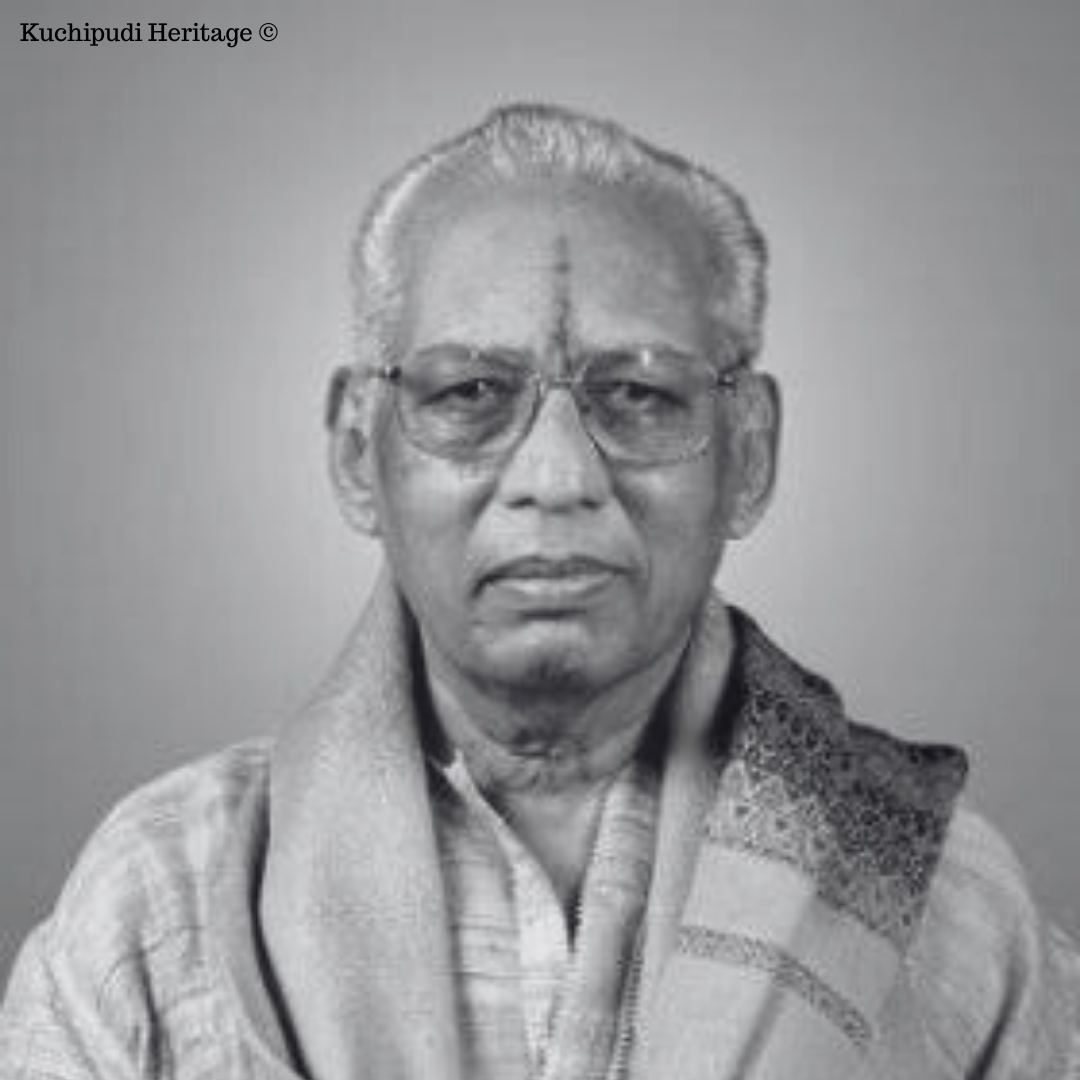
late. Vempati China Satyam
(1929 – 2012)
Born to Varalakshmamma and Chalamayya; disciple of Tadepalli Perayya and Pasumarti Kondala Rayudu; Vempati Chinna Satyam further developed his skills under his elder cousin Vempati Peda Satyanarayana and was very deeply influenced and perfected the form under the guidance of Vedantam Lakshminarayana Sastry; as a child artist he played the roles of Lava, Kusa, Lohitasya and Prahlada, later he portrayed the roles of Satyabhama and Gollabhama, and of Shiva in his own production Ksheerasagara Mathanam. Founded the Kuchipudi Art Academy in 1963 at Madras, with the objective of reviving the lost glory of the Kuchipudi dance form and provided it with a respectable place in the world of Indian dances; the Art Academy, since then, evolved into a premier institute, disseminat- ing the art of Kuchipudi dance to innumerable practitioners; his notable contribution to the dance dramas of Kuchipudi commenced with the production of Ksheera Sagara Mathanam (1961), Sri Krishna Parijatham, Sakuntalam (1963), Kumara Sambhavam (mid sixties), Chandalika (1966), Vipranarayana, Menaka Viswamitra Padmavathi Srinivasa Kalyanam (1975), Kalyana Rukmini (1984), Haravilasam (1985) and latest in the series being Sivadhanurbangam (1992) Padmavathi Srinivasam produced at the behest of Tirumala Tirupati Devesthanam, Readmore..

late. Vedantam Satyanarayana Sarma
(1934 – 2012)
born to Subamma and Venkataratnam, embarked on his artistic journey under the guidance of his elder brother Prahlada Sarma. However, it was under the mentorship of the renowned Kuchipudi exponent, Chinta Krishna Murthy, that he truly honed his skills. His musical education was enriched under the tutelage of Varanasi Brahmaiah Sastry. From the tender age of seven, Satyanarayana Sarma graced the stage, initially portraying child characters such as Lava and Prahlada. As he matured, he captivated audiences with his portrayal of female roles like Usha, Sasirekha, Parvati, Devadevi, and Mohini in various Kuchipudi dance dramas. His exquisite depiction of female characters earned him admiration worldwide. As a pivotal figure in the Venkatarama Natyamandali, Satyanarayana Sarma played a crucial role in popularizing Kuchipudi dance on the global stage. His notable performances include appearances in Delhi (1964), leading a troupe in Tamil Nadu (1968), and participation in the Festival of India Celebrations in Paris (1985) and the USA (1986).Satyanarayana Sarma’s leadership roles include serving as President of Venkatarama Natyamandali since 1969 and as Principal of Siddhendra Kalakshetra, Kuchipudi (1969-74). Readmore..
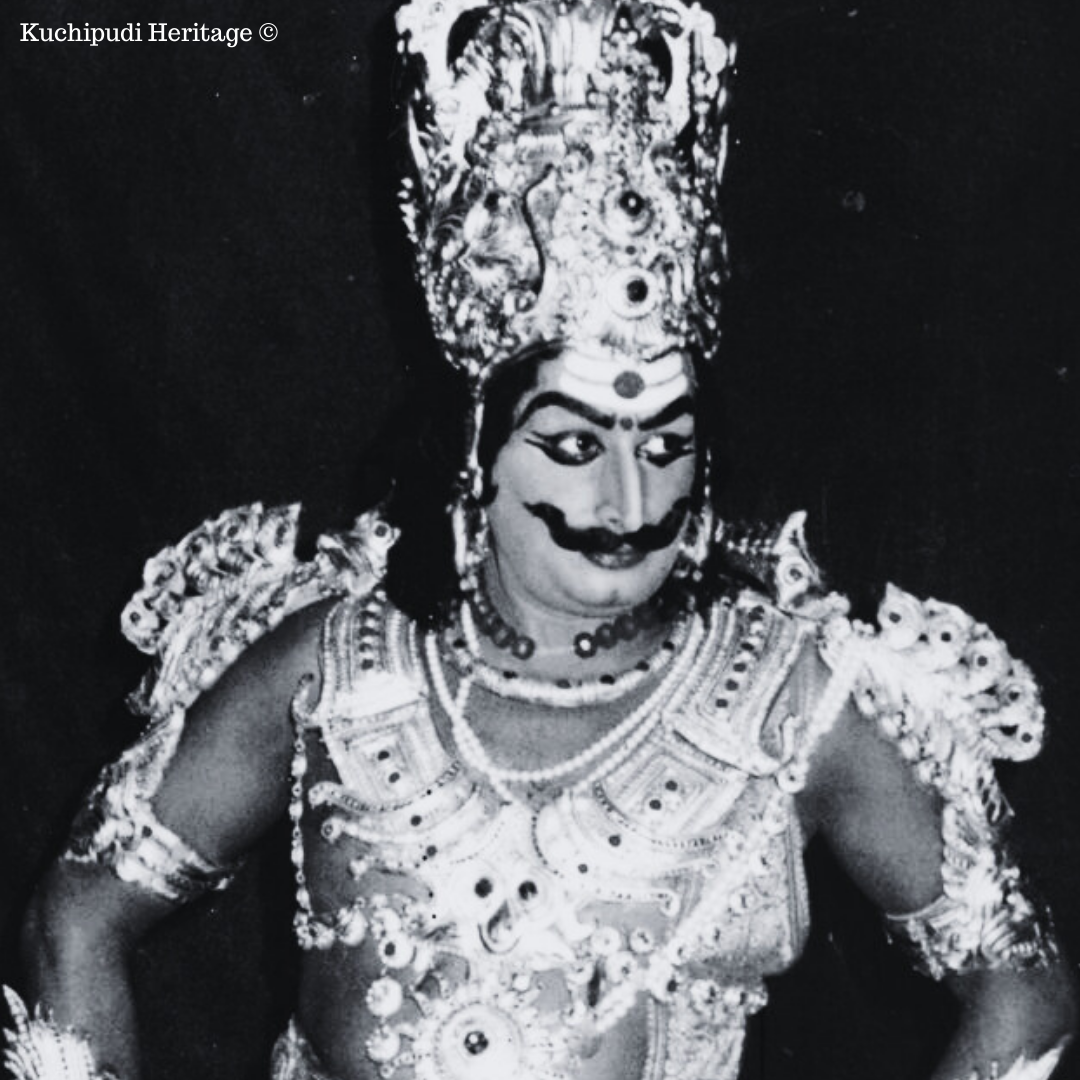
late. Vedantam Rattaiah Sarma
(1943)
born in 1943 to Annapurnamma and Ramayya, emerges as a distinguished figure in the realm of Kuchipudi. He honed his craft under the tutelage of renowned masters such as Vedantam Parvatisam, Chinta Krishna Murthy, and Vempati Chinna Satyam. Rattayya Sarma’s prowess as a character actor is widely acknowledged, with his remarkable portrayals encompassing diverse roles including Hiranyakasipa, Banasura, Aniruddha, Siva, Sri Rama, Srinivasa, and even female characters like Rangasani. In addition to his stellar performances in earlier dance dramas, Rattayya Sarma also showcased his versatility in Vempati Chinna Satyam’s productions, essaying roles in notable works like “Akasaraja,” “Bhrigumaharshi,” and “Cholaraja” in “Padmavathi Srinivasa Kalyanam,” among others. His repertoire extends to cinematic roles as well. Having conducted over two thousand performances across the country and abroad, Rattayya Sarma has left an indelible mark on the world stage. Since 1969, he has served as a dance teacher at the Kuchipudi Kalakshetra in Kuchipudi, where he presently assumes the role of Principal. He has also lent his expertise to choreographing various productions, including “Prahlada Vijaya Yakshagana,” “Girija Kalyanam,” “Ardhanariswara,” “Ksheerasagara Mathanam,” and “Bhamakalapam.” Readmore..

late. Uma Ramarao
(1940)
also known as Uma Maheswari, emerges as a pioneering figure in the realm of Kuchipudi, belonging to the first generation of gurus in this art form. Hailing from a non-traditional family in the Kuchipudi village, she carved her niche as a distinguished teacher, possibly being the first lady artist to achieve prominence in this domain. Uma Rama Rao’s journey in Kuchipudi began under the tutelage of renowned masters such as Nataraja Ramakrishna, Vedantam Lakshminarayana Sastry, and C.R. Acharyulu. Her pursuit of excellence extended to Bharatanatyam, where she honed her skills under the guidance of P.V. Narasimha Rao and K.N. Pakkiriswamy Pillai. After a successful performing career until 1961, she transitioned into the realm of teaching. As a senior lecturer at the Sri Tyagaraja Government College of Music and Dance, Hyderabad, Uma Rama Rao made significant contributions to the propagation of Indian classical dances. In 1985, she co-founded Lasya Priya, an initiative aimed at promoting various classical dance forms. Renowned for her imaginative choreography, she curated several dance dramas and features, showcasing her students’ talents on national and international platforms. Uma Rama Rao’s influence transcends geographical boundaries, with her travels taking her to the UK, West Germany, France, Austria, the Middle East, Gulf countries, Hong Kong, USA, and Canada. Readmore..
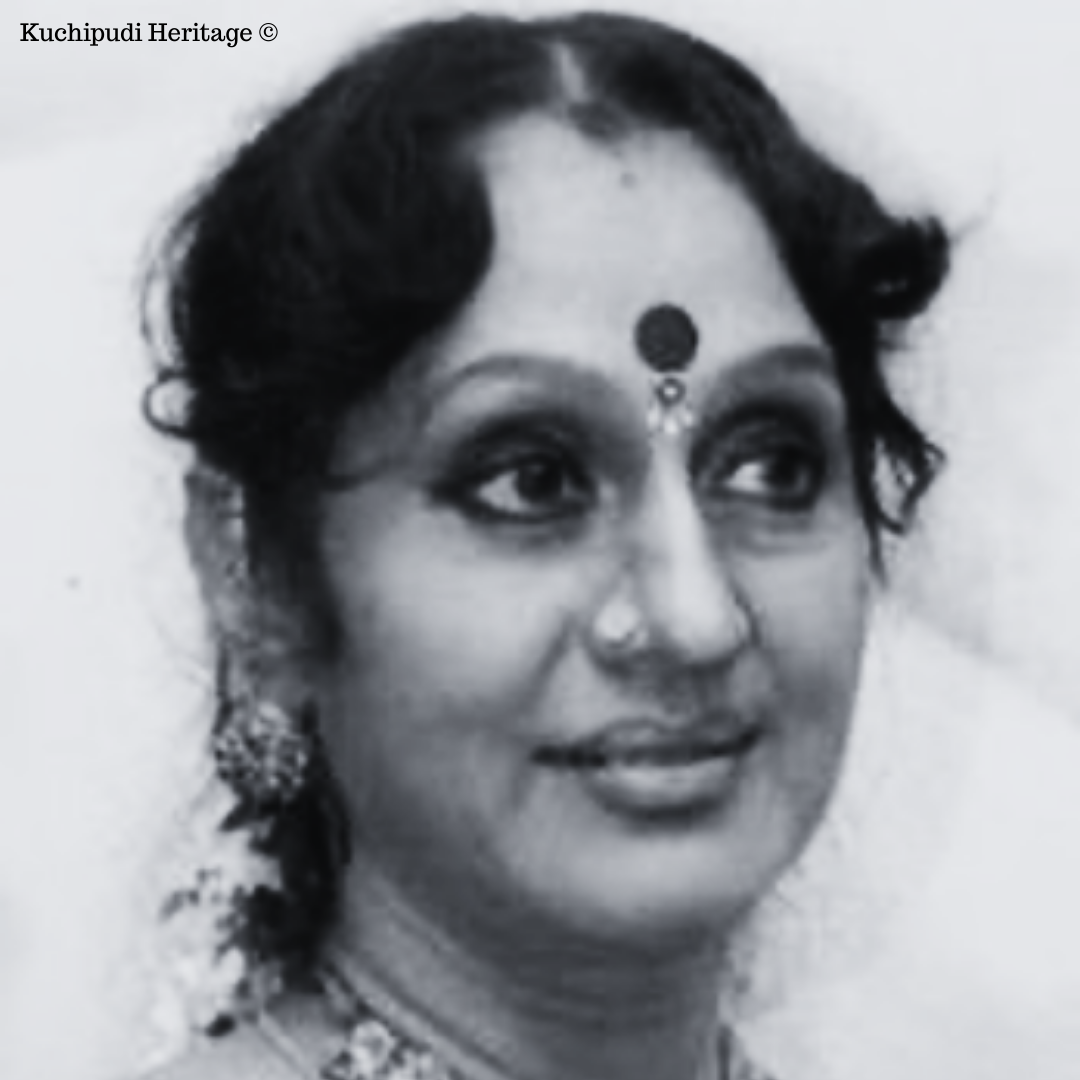
late. Sobha naidu
(1954)
daughter of Sarojini Devi and K.V. Naidu, emerged as a prominent figure in the world of Kuchipudi dance. Under the mentorship of Vempati Chinna Satyam, she honed her skills and developed a deep connection with the art form. Since the 1960s, Sobha Naidu has been associated with the Kuchipudi Art Academy in Madras, showcasing her expertise and passion for Kuchipudi. Her remarkable talent was evident from her debut performance in 1969. Renowned not only as a solo performer but also as a character role artist, Sobha Naidu portrayed major roles in ballets crafted by Vempati Chinna Satyam. Her portrayals of characters like Menaka in “Menaka Viswamitra,” Mohini in “Ksheerasagara Mathanam,” and Satyabhama in “Sri Krishna Parijatham” were particularly noteworthy. Sobha Naidu’s artistic endeavors extended beyond national boundaries as she performed extensively across the globe. She led cultural delegations to countries such as Mexico, Trinidad, Venezuela, Cuba, Kuwait, West Asia, Mauritius, USA, and USSR during various tours. As the Principal of the Kuchipudi Art Academy in Hyderabad since 1980, Sobha Naidu showcased her prowess not only as a performer but also as a choreographer and teacher. She choreographed notable dance dramas like “Kalyana Srinivasam” (1989) and “Sri Krishnah Saranam Mama” (1993), along with numerous solo performances. Readmore..
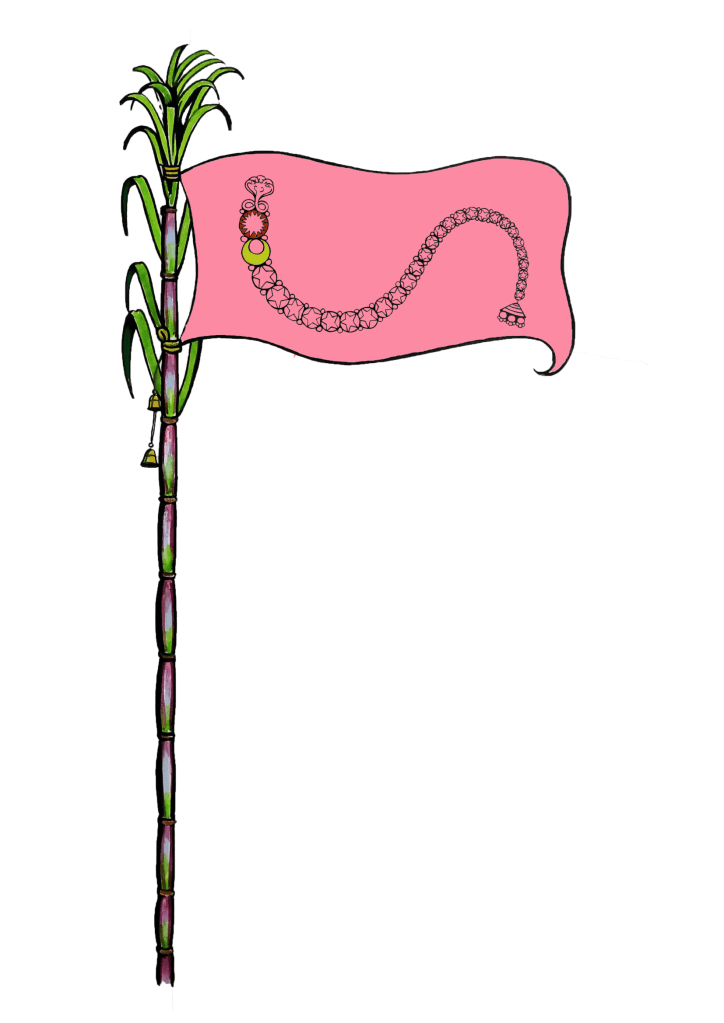
Flags are more than just pieces of cloth – they are multifaceted symbols that serve various purposes. They represent the history, culture, and values of a nation or organization, and symbolize the principles and beliefs that define their identity. Flags embody the collective identity of a people, evoking deep feelings of patriotism, national pride, and unity. The design and colors of a flag often have specific meanings, which add depth and significance to its symbolism.
In Kuchipudi, a traditional Indian dance form, the flag (patakam) created in 1974 plays a significant role in representing not just an idea, but also appealing to the idea of unity in diversity. The Kuchipudi patakam is a quadrangular banner made of cloth coloured in a light pink hue. A sugarcane stalk is used as a pole to hoist the flag, and the Satyabhama Jada (plait) is painted on the cloth.
Every part of the Kuchipudi flag has its significance. The banner represents the four varnas (social classes) as well as the four Vedas (sacred texts), conveying the message that natyam is for everyone and that it is a combination of all four Vedas. The light pink colour represents the early morning sun rays, symbolizing freshness, hope, and new beginnings.
The sugarcane stalk represents the mellifluous artistic essence of Kuchipudi, the sugarcane stalk (or stick) is used as a pole to hoist the flag. It’s a symbolic element that represents the strong and sturdy foundation of the art form, as well as the sweetness and beauty of the dance. while the leaves hovering on it represent the sanchari bhavas (transitory moods).
The Satyabhama Jada, a symbolic plait, represents the universe and human psychology. At the apex, a parrot symbolizes ego, followed by the Adi Sesha (the great serpent) representing intelligence and wisdom. The Trimurthis (Brahma, Vishnu, and Shiva) and Navartanas (9 precious gems) are also depicted. The plait features 27 stars, representing Hindu astrology, and 3 major balls denoting the three worlds and 9 planets. Some interpret the 12 balls as the 12 zodiac signs. The Jada has two types: smaller and bigger, with the latter having 108 petals. It embodies feminine beauty and represents the universe, nature, and the divine. Pride, symbolized by the parrot, is also a facet of the divine.
In conclusion, the Kuchipudi flag is a vibrant symbol of unity, diversity, artistic expression, and sovereign power. Its intricate design and colors convey the rich cultural heritage and philosophical significance of Kuchipudi. The flag’s various elements, represent the harmony of diverse elements and the pursuit of artistic excellence. As a symbol of unity in diversity, the Kuchipudi flag reminds us of the power of art to bring people together and transcend boundaries. At the same time, it celebrates the individual’s identity and their unique artistic expression, encouraging creativity, self-expression, and personal growth. Additionally, the flag represents the sovereign power of the artist, the freedom to create and express oneself without bounds. The flag’s significance extends beyond the dance form itself, inspiring us to embrace our differences, appreciate the beauty of diversity, and find unity in our shared human experience.
 Kuchipudi Heritage Arts Society